Can Part Time Georgetown Law Do Law Review Journal
| Georgetown University Constabulary Center | |
|---|---|
 | |
| Motto | Law is but the means — Justice is the end [1] |
| Parent school | Georgetown University |
| Religious affiliation | Roman Cosmic (Jesuit) |
| Established | 1870 (1870) |
| School type | Private constabulary school |
| Parent endowment | $1.661 billion[two] |
| Dean | William Treanor |
| Location | Washington, D.C., The states 38°53′54″N 77°0′45″W / 38.89833°N 77.01250°Due west / 38.89833; -77.01250 |
| Enrollment | 2,440: 1,982 JD, 441 LLM, 17 SJD |
| Faculty | 285: 126 full-time, 159 part-time |
| USNWR ranking | 14th (2023)[three] |
| Bar pass rate | 90.96%[4] |
| Website | www |
| ABA profile | Georgetown Police force Profile |
The Georgetown University Constabulary Center (Georgetown Law) is the law school of Georgetown University, a individual inquiry university in Washington, D.C.. It school was established in 1870 and is the second-largest police school in the United States by enrollment,[5] receiving more full-time applications than any other law schoolhouse in the country.[half-dozen]
A leading institution in constitutional, technology, and international law,[seven] numerous alumni have entered public service. The school's campus is several blocks from the U.S. Capitol Building, the heart of the legislative branch of Us government, and maintains a close association with the highest court in the U.s. judicial co-operative, the nearby U.S. Supreme Court.[8] Georgetown is consistently ranked among the about prestigious police force schools in the United States, occasionally shifting between 12th and 14th place, where it currently sits.[9]
Prominent alumni include 91 members of the Us Congress,[x] federal and state judges, billionaires, diplomats, and a President of the United States. Georgetown is likewise ranked in the top ten law schools for business organisation and corporate police; international, criminal, environmental, wellness care, and tax law; as well equally first in clinical training and part-time legal studies.[11]
In the 2021 Academic Ranking of World Universities,[12] Georgetown Law was ranked as the 13th all-time law school in the world.
History [edit]


All that remains of Georgetown Constabulary's original building in Judiciary Square (left) is the arch from in a higher place the doorway (right)
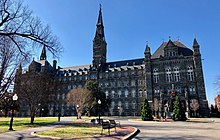
Opened every bit Georgetown Law Schoolhouse in 1870, Georgetown Police force was the 2d (later St. Louis University) police force schoolhouse run past a Jesuit institution within the United States.[13] [xiv] [a] Georgetown Law has been separate from the main Georgetown campus (in the neighborhood of Georgetown) since 1890, when it moved almost what is now Chinatown. The Law Center campus is located on New Jersey Avenue, several blocks n of the Capitol, and a few blocks w of Wedlock Station. The schoolhouse added the Edward Bennett Williams Police force Library in 1989 and the Gewirz Pupil Center in 1993, providing on-campus living for the commencement fourth dimension. The "Campus Completion Project" finished in 2004 with the addition of the Hotung International Building and the Sport and Fitness Center.
Georgetown Constabulary'south original wall (or sign) is preserved on the quad of the present-day campus.
Georgetown Law is 1 of the nearly prestigious law schools in the world.
Admissions [edit]
For the class entering in the fall of 2021, roughly 1,800 out of xiv,052 J.D. applicants (12.9%) were offered admission, with 561 matriculating, marking the nigh competitive law schoolhouse admission cycle and the largest applicant pool for any U.Southward. constabulary school in history. The median LSAT score for the class entering in fall of 2021 is 171 and the median undergraduate GPA is 3.85. In the 2020–21 bookish year, Georgetown Law had 2,021 J.D. students, of which 26% were minorities and 55% were female.[15]
Employment [edit]
Of the 691 J.D. graduates in the Georgetown Law class of 2020 (including both full- and part-time students), 569 (82.3%) held long-term, full-time positions that required bar exam passage (i.e., jobs as lawyers) and were non schoolhouse-funded nine months subsequently graduation.[17] 644 graduates overall (93.2%) were employed, 6 graduates (0.9%) were pursuing a graduate degree, and 34 graduates (4.9%) were unemployed.[17]
435 J.D. graduates (63.0%) were employed in the private sector, with 368 (53.iii%) at law firms with over 250 attorneys.[17] 208 graduates (thirty.i%) entered the public sector, with eighty (11.6%) employed in public involvement positions, 55 (8.0%) employed past the government, 68 (9.8%) in federal or state clerkships, and five (0.7%) in academic positions.[17] 35 graduates (5.1%) received funding from Georgetown Police for their positions.[17]
The median reported starting bacon for a 2018 J.D. graduate in the individual sector was $180,000. The median reported starting salary for a 2018 graduate in the public sector (including regime, public interest, and clerkship positions) was $57,000.[18]
272 J.D. graduates (39.four%) in the class of 2020 were employed in Washington, DC, 155 (22.4%) in New York, and 31 (4.5%) in California. 13 (1.ix%) were employed outside the Us.[17]
As of 2011, Georgetown Police alumni account for the 2nd highest number of partners at NLJ 100 firms. Information technology is among the top ten feeder schools in 8 of the ten largest legal markets in the U.s. by constabulary chore openings (New York, Washington DC, Chicago, Los Angeles, Boston, Houston, San Francisco, and San Diego), once more giving it the second-widest reach of all police force schools. The schoolhouse performs peculiarly strongly in its domicile market, where information technology is the largest police force school and has produced the greatest number of NLJ 100 partners.[19]
Georgetown Law was ranked #eleven for placing the highest per centum of 2018 J.D. graduates into acquaintance positions at the 100 largest law firms.[20]
Costs [edit]
The total cost of attendance (indicating the cost of tuition, fees, and living expenses) at Georgetown Law for the 2021–2022 academic year is $99,600.[21] The Police School Transparency estimated debt-financed cost of attendance for 3 years is $352,279.[22]
Campus [edit]
The Law Center is located in the Capitol Hill area of Washington, D.C. Information technology is bounded by 2d St. NW to the west, E St. NW to the south, 1st St. NW and New Bailiwick of jersey Avenue to the east, and Massachusetts Artery to the north.
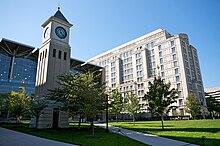
The campus consists of five buildings. Bernard P. McDonough Hall (1971, expanded in 1997) houses classrooms and Police Center offices and was designed by Edward Durell Stone. The Edward Bennett Williams Law Library building (1989) houses most of the school's library collection and is i of the largest police libraries in the Us. The Eric East. Hotung International Law Centre (2004), named afterwards Hong Kong businessman and philanthropist Eric Edward Hotung, includes two floors of library infinite housing the international collection, and also contains classrooms, offices, and coming together rooms. The Bernard S. and Sarah M. Gewirz Student Eye (1993) provides apartment-style housing for 250–300 students too as hosting offices for nine bookish centers and institutes, the Constabulary Centre'due south Student Health dispensary, the Center for Health Promotion, the Counseling and Psychiatric Service office, a dedicated prayer room for Muslim members of the Police force Centre community, a moot court room, a daycare (the Georgetown Law Early Learning Heart), and a ballroom event infinite ordinarily used for academic conferences. The iv-level Scott K. Ginsburg Sport & Fitness Heart (2004) includes a pool, fettle facilities, and buffet, and connects the Hotung Building to the Gewirz Student Eye.
Libraries [edit]
The Georgetown Police Library supports the research and educational endeavors of the students and kinesthesia of the Georgetown University Constabulary Center. Information technology is the second largest law schoolhouse in the United States, and as one of the premier research facilities for the report of constabulary, the Law Library houses the nation's quaternary largest law library collection and offers access to thousands of online publications. The Law Library was ranked by The National Jurist as the 14th best law library in the nation in 2010.[23]
The mission of the library is to back up fully the research and educational endeavors of the students and faculty of the Georgetown University Law Center, by collecting, organizing, preserving, and disseminating legal and law related data in whatever form, past providing constructive service and instructional programs, and past utilizing electronic data systems to provide access to new information products and services.
The collection is split into two buildings. The Edward Bennett Williams Law Library (1989) is named after Washington, D.C. lawyer Edward Bennett Williams, an alumnus of the Law Center and founder of the prestigious litigation firm Williams & Connolly. It houses the Law Center's United States police force collection, the Law Center Athenaeum, and the National Equal Justice Library. The Williams library edifice consists of five floors of drove and report infinite and provides office space for almost of the Law Center'south police journals on the Law Library's first level.
The John Wolff International and Comparative Police force Library (2004) is named afterward John Wolff, a long-serving member of the offshoot faculty and supporter of the Constabulary Centre's international law programs. The library is located on ii floors inside the Eric E. Hotung edifice. It houses the international, strange, and comparative law collections of the Georgetown University Law Center. Wolff Library collects primary and secondary law materials from Australia, Canada, French republic, Federal republic of germany, Great U.k., Republic of ireland, Mexico, New Zealand, Scotland, and S Africa. English language translations of primary and secondary legal materials from other jurisdictions and compilations of foreign law on special topics are also included.
In add-on to foreign law, the Wolff Library maintains an extensive collection of public and individual international law, focusing on international merchandise, international environmental law, human rights, arbitration, tax and treaty law. The drove also includes documentation from many international organizations, including the International Courtroom of Justice, the Un, the European Matrimony, and the World Trade Arrangement.
Curriculum [edit]

The reading room for students in the Edward Bennett Williams Police force Library

With its strategic location in Washington, the law school has received many distinguished guest speakers like the 46th President of the U.s.a., Joseph R. Biden.
Georgetown Law'southward J.D. plan can be completed over iii years of full-time day study or three to four years of part-time evening report. The schoolhouse offers several LL.Grand. programs in specific areas, most notably tax law, as well equally a general LL.M. curriculum for lawyers educated exterior the United states. Georgetown launched a Master of Studies in Law (M.S.L.) degree program for professional journalists in the 2007–08 academic year. It also offers the highest doctoral degree in law (J.S.D.).
Students are offered the choice of two tracks for their first year of study. "Curriculum A" is a traditional police force curriculum similar to that taught at virtually schools, including courses in civil procedure, constitutional police force, contracts, criminal justice, holding, torts, and legal research and writing. 4-fifths of the mean solar day students at Georgetown receive pedagogy nether the standard program (sections 1, two, 4, and 5).
"Curriculum B" is a more interdisciplinary, theoretical approach to legal study, covering an equal or wider telescopic of textile but heavily influenced by the disquisitional legal studies movement. The Curriculum B courses are Deal, Commutation and Liability (contracts and torts), Democracy and Coercion (ramble law and criminal procedure), Authorities Processes (administrative constabulary), Legal Justice (jurisprudence), Legal Practice (legal research and writing), Legal Process and Gild (civil procedure), and Property in Fourth dimension (holding). 1-fifth of the full-time JD students receive instruction in the alternative Curriculum B program (Department three).
Students in both curricula may participate in a week-long introduction to international law betwixt the fall and spring semesters.
Clinics / programs [edit]
Georgetown has long been nationally recognized for its leadership in the field of clinical legal education. In 2018, U.Due south. News ranked Georgetown #1 in the nation for Clinical Training, followed by New York University (2nd), CUNY (3rd), American University (4th), and Yale University (5th).[24] Over 300 students typically participate in the programme.
Georgetown's clinics are: Appellate Litigation Clinic, Center for Applied Legal Studies, The Community Justice Project, Criminal Defence force & Prisoner Advocacy Clinic, Criminal Justice Clinic, D.C. Law Students in Court, D.C. Street Law Program, Domestic Violence Clinic, Federal Legislation and Administrative Clinic, Harrison Institute for Housing & Community Evolution Clinic, Harrison Establish for Public Constabulary, Institute for Public Representation, International Women'south Human Rights Clinic, and Juvenile Justice Clinic.

Georgetown Police force highlights in its legal instruction the scholarly qualities of cura personalis, "educational activity the whole person," from the academy'southward founder John Carroll.
In the Winter 2017 edition of The National Jurist, Georgetown Law'due south Moot Court Program was ranked #four in the land for 2015–16 and #5 amidst U.S. constabulary schools that have had the best moot courts this past decade.[25]
Appellate Litigation Clinic [edit]
Directed by Professor Erica Hashimoto (following 36 years of leadership past Professor Steven H. Goldblatt), the Appellate Litigation Clinic operates akin to a small appellate litigation firm. Information technology has had four cases accomplish the Us Supreme Court on grants of writs of certiorari.[26] One such case was Wright five. Due west, 505 U.S. 277 (1992), considered in habeas corpus the question whether the de novo review standard for mixed questions of law and fact established in 1953 (the Brown v. Allen standard) should be overruled. Another was Smith v. Barry, 502 U.Southward. 244 (1992), which reversed a Quaternary Circuit determination that the courtroom did non have jurisdiction over an appeal because the accused's pro se brief could not serve as a timely detect of entreatment.
Centre for Applied Legal Studies [edit]
CALS represents refugees seeking political asylum in the U.s.a. because of threatened persecution in their dwelling house countries. Students in CALS assume primary responsibility for the representation of these refugees, whose requests for asylum have already been rejected by the U.S. government.[27] The Center for Practical Legal Studies was founded in the 1980s by Philip Schrag.[28] Until 1995, the Clinic heard cases in the field of consumer protection. Under the management of Schrag and Andrew Schoenholtz, the Clinic began specializing in asylum claims, for both detained and non-detained applicants.[29] In conjunction with their work for the Clinic, Schrag and Schoenholtz have written books about America's political asylum system, with the help of Clinic fellows and graduate students. The duo's most recent volume, Lives in the Balance, was published in 2014 and provides an empirical analysis of how Homeland Security decided asylum cases over a recent 14-year catamenia.[30] The grouping'south work in human rights police force has met praise from international organizations similar the United nations Human Rights Council.[31] Under the direction of Schrag and Schoenholtz, the clinic has likewise focused on more prolonged displacement situations for political refugees.[32]
Civil Rights Clinic [edit]
CRC operates every bit a public interest law firm, representing individual clients and other public interest organizations, primarily in the areas of discrimination and constitutional rights, workplace fairness, and open authorities.[33] The Clinic is directed by Professor Aderson Francois, who joined in 2016.[34] Students work with CRC staff attorneys to litigate Liberty of Information Human activity claims, wage theft suits, and retaliation claims on behalf of employees terminated for asserting their rights under FLSA and DC Wage and Hour police force.
Criminal Defense and Prisoner Advocacy Clinic [edit]
Students in CDPAC represent defendants facing misdemeanor charges in D.C. Superior Court, facing parole or supervised release revocation from the United States Parole Commission working with the Public Defender Service for the District of Columbia, and they also work on prisoner advocacy projects.[35] Abbe Smith is the director of CDPAC.[36] Former Public Defender Service for the Commune of Columbia lawyer Vida Johnson works with Smith in CDPAC and the Prettyman fellowship program.[37]
DC Street Police force Program [edit]
The DC Street Law Program, Directed by Professor Charisma 10. Howell, provides legal educational activity to the DC population through ii projects: the Street Law High Schools Clinic and the Street Police force Community Dispensary. Professor Richard Roe directed the Street Police force Loftier Schools Clinic since 1983. Professor Howell became the director in 2018. In the program, students innovate local loftier schoolhouse students to the bones structure of the legal system, including the relationship amidst legislatures, courts, and agencies, and how citizens, especially in their world, chronicle to the lawmaking processes of each branch of government.[38] [39]
Harrison Institute for Public Law [edit]
The Harrison Institute is one of the longest running public police force clinics in the country, having begun as the Projection for Customs Legal Help in 1972. In 1980 it was renamed in honor of Anne Blaine Harrison, a philanthropist and early supporter of the found.[40] Over its history, the institute has been home to several clinical programs, including focuses on land and local legislation, administrative advocacy, housing and community development, and policy. In 2019, under the directorship of Robert Stumberg, the found consists of four policy teams: Climate, Health, Human Rights, and Trade.[41] Each of these teams involves students working to shape policy to reach client goals.
Faculty [edit]

Gewirz Student Center provides student housing for more often than not get-go-year law students.
Notable current faculty include:
- Charles F. Abernathy, Professor of civil rights and comparative law
- Lama Abu-Odeh, Palestinian-American scholar of Islamic law, family law, and feminism
- Randy Barnett, Libertarian constitutional police force scholar, author of The Structure of Liberty and Restoring the Lost Constitution, 2008 Guggenheim Swain
- Rosa Brooks, Professor of national security, military, and international law, columnist for Foreign Policy
- Paul Butler, Professor of criminal constabulary and civil rights, skilful on jury nullification
- Sheryll D. Cashin, Professor of civil rights and housing law
- Julie East. Cohen, Professor of copyright, intellectual property, and privacy law
- Anthony East. Cook, Professor of civil rights, bigotry, and social welfare law
- David D. Cole, Professor of starting time amendment and criminal procedure law
- Peter Edelman, former Assistant Secretary of Health and Human Services
- Doug Emhoff, Distinguished Visitor from Do, Distinguished Swain of Georgetown Law's Institute for Applied science Law and Policy, Second Admirer of the United States, lawyer
- Heidi Li Feldman, Professor of constabulary
- Lawrence O. Gostin, Professor of public health police
- Shon Hopwood, Associate Professor, convicted banking concern robber turned jailhouse lawyer who represented matters before the Supreme Courtroom
- Neal Katyal, Erstwhile Acting Solicitor Full general of the United States, Professor of national security law
- Donald Langevoort, Thomas Aquinas Reynolds Professor of Constabulary, preeminent scholar in securities law and regulation
- Marty Lederman, Associate Professor, Deputy Banana Attorney General at the Department of Justice Office of Legal Counsel
- Naomi Mezey, Professor of police force and civilization
- Eleanor Holmes Norton, Delegate representing Washington, DC in the U.South. Firm of Representatives
- Victoria F. Nourse, Chief Counsel to Vice President Joe Biden and principal author of the Violence Confronting Women Act
- Ladislas Orsy, canonical theologian
- Gary Peller, Prominent fellow member of critical legal studies and critical race theory movements
- Nicholas Quinn Rosenkranz, former chaser-advisor at the Office of Legal Counsel in the U.Due south. Department of Justice
- Philip Schrag, Director of the Center for Practical Legal Studies, Delaney Family Professor of Public Interest Police
- Louis Michael Seidman, Carmack Waterhouse Professor of Ramble Law, significant proponent of the critical legal studies motion
- Howard Shelanski, Erstwhile Ambassador of the Office of Data and Regulatory Affairs
- Abbe Smith, Criminal Defense Attorney and Manager of the Criminal Defense & Prisoner Advancement Dispensary
- Daniel K. Tarullo, Fellow member of the Lath of Governors of the Federal Reserve Organisation
- Robert Thompson, Peter P. Weidenbruch, Jr. Professor of Business Law, ane of the nation's foremost experts in corporate and securities police
- William M. Treanor, Dean of Georgetown University Law Heart, onetime dean of Fordham University Schoolhouse of Police, noted constitutional constabulary proficient
- Rebecca Tushnet, Professor of copyright, trademark, intellectual property, and first amendment constabulary, noted for her scholarship on fanfiction
- David Vladeck, Former Director of the Bureau of Consumer Protection at the Federal Trade Commission
- Robin West, Frederick J. Haas Professor of Law and Philosophy, proponent of feminist legal theory and the constabulary and literature movement
Publications [edit]
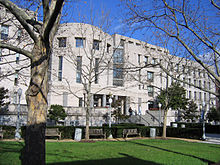
Edward Bennett Williams Law Library, viewed from the campus north quad.
Georgetown Academy Law Centre publishes fourteen student-run police force journals, two peer-reviewed constabulary journals, and a weekly pupil-run newspaper, the Georgetown Law Weekly. The journals are:
- American Criminal Law Review
- Food and Drug Police force Journal [42]
- Georgetown Environmental Law Review
- Georgetown Immigration Police force Journal
- Georgetown Journal of Gender and the Law
- Georgetown Journal of International Law
- Georgetown Journal of Law and Modern Disquisitional Race Perspectives
- Georgetown Journal of Law and Public Policy
- Georgetown Periodical of Legal Ethics
- Georgetown Journal on Poverty Police and Policy
- Georgetown Law Periodical
- Journal of National Security Law and Policy [43]
- Georgetown Law Technology Review [44] (exclusively online)
In 2021, the Georgetown Law Journal was ranked by Google Scholar and Washington and Lee School of Police as the #4 and #5 almost influential constabulary review in the country, respectively.[45]
The Georgetown Constabulary Journal was as well ranked #eight in the nation based on the 2021 Meta Ranking of Flagship US Police Reviews at U.Due south. law schools by Assistant Professor Bryce Clayton Newell.[46]
Controversies [edit]
In January 2022, Ilya Shapiro, the incoming executive manager and senior lecturer of the Georgetown Center for the Constitution, wrote in a tweet that he opposed President Biden's intent to nominate a black woman to the Supreme Court, writing that because Biden would not nominate Shapiro's friend Sri Srinivasan, he was choosing a "lesser blackness woman."[47] The dean of Georgetown Academy Law Center condemned the remarks, stating, "The tweets' suggestion that the best Supreme Court nominee could not exist a Blackness woman and their apply of demeaning language are appalling...The tweets are at odds with everything we correspond at Georgetown Law." Shapiro later deleted the tweet also equally many other tweets he had written in the past, and issued a statement calling information technology an, "inartful tweet."[48] Shapiro was then placed on authoritative leave while existence investigated for violations of "professional acquit, non-discrimination, and anti-harassment" rules.[49]
Notable alumni [edit]
Notes [edit]
- ^ Although information provided on Georgetown Law'due south website claims when they were founded in 1870, the school was the start law schoolhouse in the United States instituted past a Jesuit run institution. This is merely untrue yet, as the also Jesuit run St. Louis Academy opened a law school decades earlier, in 1843. It is not articulate how or why officials from Georgetown came to believe otherwise.
References [edit]
- ^ Expressed by Joseph A. Cantrel (Grade of 1922), at the 50th Anniversary Celebration in December 1920. Run into official site Archived July 11, 2007, at the Wayback Machine
- ^ As of June 30, 2017. "U.S. and Canadian Institutions Listed past Fiscal Yr (FY) 2017 Endowment Market Value and Change in Endowment Market Value from FY 2016 to FY 2017" (PDF). National Clan of College and University Business concern Officers and Commonfund Found. 2017. Archived from the original on Feb 26, 2018.
{{cite spider web}}: CS1 maint: bot: original URL status unknown (link) - ^ "US News Law School Rankings".
- ^ "School Detail Data". lsac.org.
- ^ 125th Anniversary – Georgetown Police force Library, Georgetown University Law Centre, Retrieved: January xxx, 2017
- ^ 10 Law Schools With the Near Full-Time Applications, U.South. News & World Report, Published: March 31, 2016. Retrieved: Jan 30, 2017
- ^ "USNWR Law School Rankings: Georgetown Police School". usnews.com . Retrieved August 14, 2020.
- ^ "Visit Our Campus". www.law.georgetown.edu . Retrieved August 14, 2020.
- ^ "Law schoolhouse rankings in the United states", Us News, 2022-28-31, retrieved 2022-03-23
- ^ "11 Georgetown Law Alumni Will Serve in the 117th Congress". Retrieved January 5, 2021.
- ^ "USNWR Constabulary School Rankings: Georgetown University". usnews.com . Retrieved Baronial 14, 2020.
- ^ "Academic Ranking of World Universities 2021 - Law". Academic Ranking of Earth Universities. 2021.
- ^ "Timeline of Saint Louis Academy". https://www.slu.edu/timeline/ Saint Louis University. Retrieved December 30, 2020.
- ^ "Most". www.law.georgetown.edu . Retrieved Dec 30, 2020.
- ^ "2020 Standard 509 Information Study" (PDF). American Bar Clan. Retrieved December 12, 2020.
- ^ "Employment Summary for 2020 Graduates" (PDF).
- ^ a b c d east f "American Bar Association Employment Summary for 2020 Graduates – Georgetown Constabulary" (PDF) . Retrieved October 3, 2021.
- ^ "Georgetown University Police Center Class of 2018 Summary Report" (PDF) . Retrieved November 15, 2020.
- ^ Theodore P. Seto (2011). "Where Practice Partners Come up From?". Journal of Legal Education. SSRN 1903934.
- ^ "Sneak Peek at the 2019 Become-To Law Schools: Nos. xi–xx | Law.com". Law.com . Retrieved April 17, 2019.
- ^ "Tuition & Cost of Omnipresence". www.constabulary.georgetown.edu.
- ^ "Georgetown University, Finances". world wide web.lstreports.com.
- ^ "All-time Law Libraries | the National Jurist". www.nationaljurist.com. October 12, 2010. Retrieved April 28, 2018.
- ^ "All-time Constabulary Schools; US News Best Graduate Schools". Retrieved April two, 2018.
- ^ "The National Jurist – Winter 2017". world wide web.nxtbook.com . Retrieved May 11, 2018.
- ^ "Appellate Litigation Clinic — Georgetown Police force". Police force.georgetown.edu. Oct 14, 2014. Retrieved Dec 3, 2015.
- ^ "Centre for Practical Legal Studies — Georgetown Law". Law.georgetown.edu. October xiv, 2014. Retrieved Dec 3, 2015.
- ^ "Faculty Receive Prestigious Medals as Presidential Fellows at Convocation | Georgetown University". Georgetown.edu. Oct 15, 2014. Retrieved December iii, 2015.
- ^ Prof, Immigration. "ImmigrationProf Blog". Lawprofessors.typepad.com. Retrieved December 3, 2015.
- ^ "Lives in the Balance | Asylum Adjudication by the Department of Homeland Security | Books". NYU Press. Retrieved Dec iii, 2015.
- ^ Schoenholtz, Andrew I. (2005). "Refugee Protection in the United states Post-September xi". Georgetown University Law Center.
- ^ Wong, Edward. ""The New Refugees and the Old Treaty: Persecutors and Persecuted in the Twenty-First Century" past Schoenholtz, Andrew I. – Chicago Journal of International Law, Vol. xvi, Issue 1, Summer 2015". Archived from the original on September 27, 2015.
- ^ Georgetown Academy Law Center. "Civil Rights Clinic".
- ^ Georgetown Academy Law Center. "Fellowships".
- ^ "Criminal Defense force & Prisoner Advocacy Clinic (CDPAC)". law.georgetown.edu.
- ^ "Profile Abbe Smith". law.georgetown.edu.
- ^ "CDPAC Staff". georgetown.law.edu.
- ^ "Well-nigh Our Clinic — Georgetown Law". Law.georgetown.edu. October 14, 2014. Retrieved December three, 2015.
- ^ "Street police force schools in life skills – Video on". Nbcnews.com. Baronial iii, 2012. Retrieved December three, 2015.
- ^ "The Anne Blaine Harrison Institute". The Washington Post. May v, 1978. Retrieved October 9, 2019.
- ^ "Harrison Institute for Public Law". police.georgetown.edu.
- ^ "Nutrient and Drug Law Periodical".
- ^ "Journal of National Security Law & Policy". jnslp.com.
- ^ "Georgetown Police force Technology Review". georgetownlawtechreview.org.
- ^ "2021 Meta Rankings". Meta Rankings . Retrieved December 3, 2021.
{{cite spider web}}: CS1 maint: url-status (link) - ^ "Law Periodical Ranking – Bryce Clayton Newell". Law Journal Meta . Retrieved December three, 2021.
{{cite spider web}}: CS1 maint: url-condition (link) - ^ Ma, Alexandra. "Incoming Georgetown Law professor prompts backlash by maxim Biden volition pick 'bottom Black adult female' for Supreme Courtroom". Business Insider . Retrieved January 29, 2022.
- ^ "Incoming Georgetown Constabulary ambassador apologizes after tweets dean chosen 'appalling'". Washington Mail. ISSN 0190-8286. Retrieved January 29, 2022.
- ^ "Tweet by Mark Joseph Stern of Slate Magazine". Twitter . Retrieved January 31, 2022.
External links [edit]
- Official website
- INSPIRE records, at the University of Maryland libraries. The Constitute of Public Interest Representation (INSPIRE) is part of the Georgetown University Police Heart.
Coordinates: 38°53′54″N 77°0′45″W / 38.89833°N 77.01250°W / 38.89833; -77.01250
Source: https://en.wikipedia.org/wiki/Georgetown_University_Law_Center
0 Response to "Can Part Time Georgetown Law Do Law Review Journal"
Enregistrer un commentaire